
TEA NOTES · A LITTLE SPACE TO SLOW DOWN
A gentle guide to green, white, yellow, oolong, black and dark tea—and the everyday reflections they invite.
What are the six types of Chinese tea?
The six main types of Chinese tea are green, white, yellow, oolong, black and dark tea. They are grouped by processing methods and the qualities those methods produce—not by price. In Chinese, black tea is hong cha, or “red tea”; dark tea is hei cha. These are different categories.
At HAO & LEAF, a cup of tea is also a small invitation to slow down. Understanding the leaves can deepen that pleasure, without turning it into a test of expertise. Think of these six families as different ways into the same daily ritual.
Processing, not a ladder of quality
“Fermentation level” is a familiar shortcut, but it does not tell the whole story. Oxidation is central to black tea and oolong, while microbial fermentation is important in dark tea. Yellow tea has its own yellowing step. These are different processes, rather than six exact points on a percentage scale.
The outline below shows characteristic steps, not every stage or variation in production. It is adapted from published Chinese tea-processing descriptions. See the processing reference and the overview of tea classification.
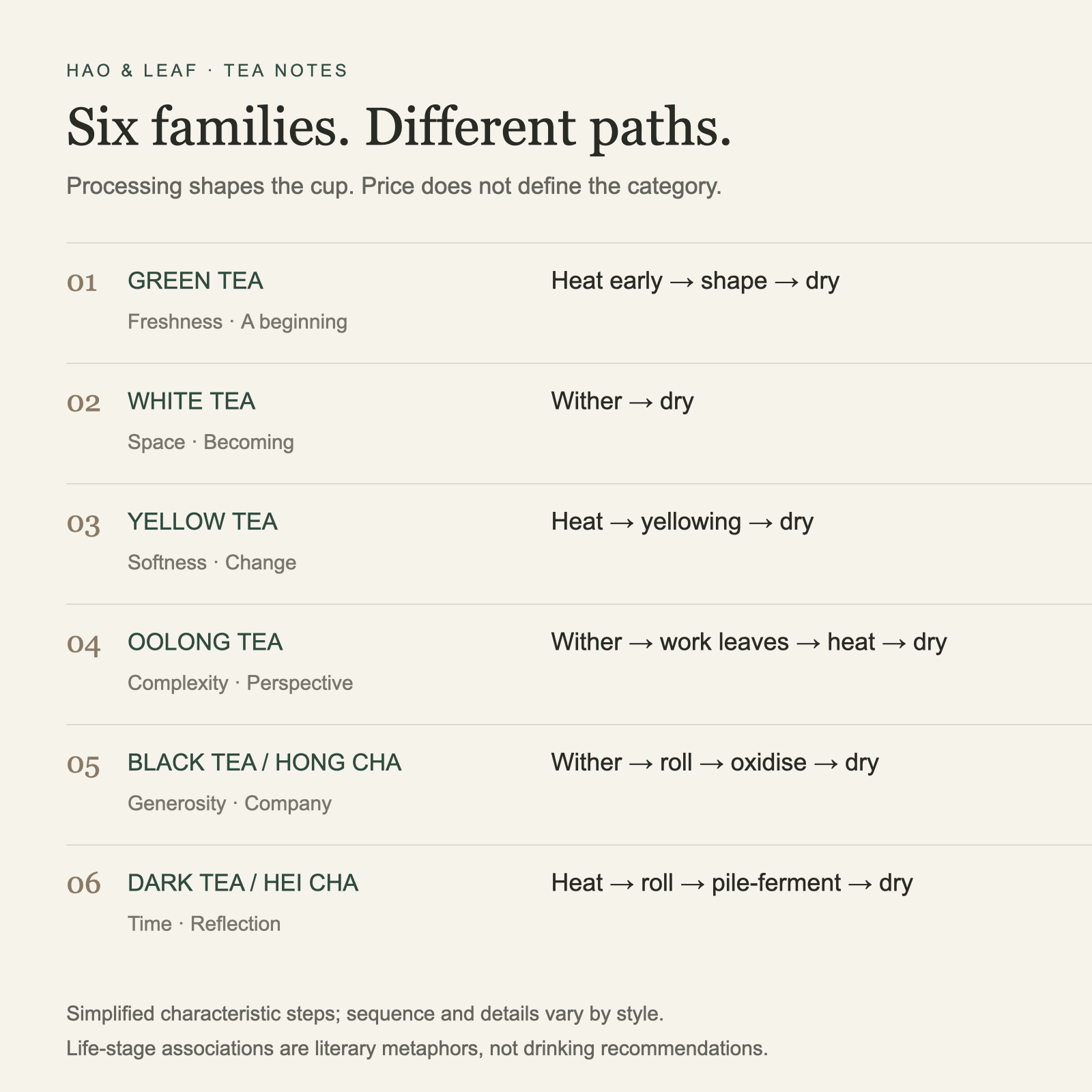
| Tea family | Simplified processing |
|---|---|
| GREEN TEA | Heat early → shape → dry |
| WHITE TEA | Wither → dry |
| YELLOW TEA | Heat → yellowing → dry |
| OOLONG TEA | Wither → work leaves → heat → dry |
| BLACK TEA / HONG CHA | Wither → roll → oxidise → dry |
| DARK TEA / HEI CHA | Heat → roll → pile-ferment → dry |
Green tea: the pleasure of a fresh beginning
Green tea is heated early in processing to limit enzymatic oxidation, then shaped and dried. Its character often centres on freshness: grassy, vegetal or gently nutty impressions, depending on the tea.
If we borrow the language of life, green tea is a reminder of beginnings—the clarity of noticing something for the first time. You do not need to be young to enjoy that feeling. Take a small sip and notice what remains after it: a texture, a fragrance, a moment of brightness.
White tea: room to become
Traditional white-tea processing centres on withering and drying. It may seem simple, but careful handling still matters. Young white tea can feel delicate and softly sweet; other examples offer a fuller experience.
White tea invites a gentler metaphor: growth does not always need to be hurried. Some white teas are kept for ageing, but time alone does not guarantee improvement. The starting material and storage conditions matter. Choose a tea for how it tastes now, rather than treating its age as a promise.
Yellow tea: softness through change
Yellow tea includes a controlled yellowing stage, known as men huang. This distinguishes its processing from green tea and helps develop its characteristic profile.
In our life-and-tea story, yellow tea suggests the quiet adjustment that follows an early challenge. Softness need not mean a loss of character. Let the metaphor encourage attention to the cup, rather than an expectation that every yellow tea will taste the same.
Oolong tea: learning to hold complexity
Oolong is partially oxidised. Its processing includes withering, working or bruising the leaves, heat treatment and drying, with further variations among styles. Floral, fruity and roasted impressions can appear across this broad family.
Oolong suits a story about experience: complexity can become something to enjoy, rather than something to resolve. The traditional image of green leaves with reddish edges describes some examples, but it is not a universal visual test for every oolong.
Black tea: a generous cup
Black tea—hong cha in Chinese—is extensively oxidised before drying. Its flavour can feel rounded and sweet, with considerable variation from one tea to another.
Here, the life metaphor is generosity: a cup that can welcome company, conversation or a quiet pause. Taste it plain first. If you enjoy milk, try it with a fuller-bodied tea and let your own preference guide you. “Warmth” in this story describes a feeling, not a claim that black tea treats stomach problems.
Dark tea: a conversation with time
Dark tea, or hei cha, is associated with post-fermentation involving microorganisms. The family includes teas with different production and storage histories; some offer mellow, earthy or woody impressions.
It is a fitting companion to the idea of perspective—what changes when we allow more time and attention? Yet older is not automatically better. Poor storage can damage tea, so age should never replace information about quality and handling. General tea purchasing and storage guidance is a useful starting point.
Curious about this family? Visit our Chinese dark tea introduction. The HAO & LEAF collection is in preparation; individual tasting notes and brewing guidance will accompany the teas when introduced.
How to choose a tea you will enjoy
Begin with curiosity rather than a price target. If you enjoy fresh flavours, explore green tea. If you prefer gentle impressions, try white or yellow tea. For aromatic variety, explore oolong; for a rounded cup, try black tea; for mellow depth, explore dark tea. These are starting points, not guarantees.
When available, try a small sample before committing to a larger amount. Follow the guidance for the particular tea, then adjust one thing at a time: leaf quantity, water temperature or steeping time. There is no single brewing recipe that suits every tea in a category.
A comfortable cup and a familiar routine are enough to begin. Our ceramic teaware introduction explores the place of everyday objects in that ritual; the collection is still being prepared.
A little clarity before your next cup
Is dark tea the same as black tea?
No. Black tea is hong cha, often translated literally as red tea. Dark tea is hei cha, a separate family associated with post-fermentation. Keeping both names in mind makes English-language tea guides easier to follow.
Is expensive tea always the better choice?
Price alone cannot tell you whether you will enjoy a tea. Clear product information, good handling and a flavour you like are more useful starting points than prestige.
Does every tea improve with age?
No. Some white and dark teas are aged intentionally, but ageing depends on the tea and its storage. Many teas are appreciated for freshness. Do not assume that an old tea is a good tea.
Do these tea types correspond to different ages of life?
Only as a literary metaphor. They are not age-based drinking recommendations or a ranking of maturity. You can enjoy any of these styles at different moments in your life.
A world within a cup
Leaves rise, settle and open. We lift a cup, then set it down.
Perhaps that is enough of a lesson for one afternoon. Tea does not need to prove your knowledge or your spending power. It can simply make a little room for attention.
山间有居,杯中有天地。
A place among the mountains. A world within a cup.
Leave a Reply